Will God Protect Born Again Christians During the Great Tribulation
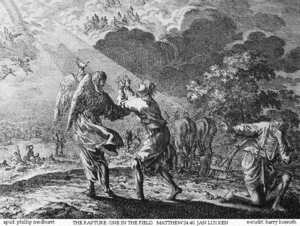
In Christian eschatology, the postal service-tribulation rapture doctrine is the belief in a combined resurrection and gathering of the saints (Post-tribulation believers practice non use the word "rapture" for the effect) coming after the Nifty Tribulation.
Doctrine [edit]
The postal service-tribulation gathering of the saints position believes that there is a resurrection of both dead and living believers in Jesus Christ at the end of the age (or the "stop time"). Mail service-tribulationists believe that Christians volition remain on the Earth throughout the vii-year tribulation period which includes the last three and a half years, which some call the "Great Tribulation". The distinguishing characteristic of the mail-tribulation view is that it believes the gathering of the saints volition occur after a 7-year tribulation flow and non before as in the pre-tribulation view. They also believe that it is a blessing to be beheaded for the testimony of Jesus, whereas pre-tribulationists believe only those who need to repent of sin will exist left behind, essentially taking the doctrine of purgatory and giving it a identify in their ain Christian doctrine.
This period starts with the appearing of the abomination of desolation (Matthew 24:xv) and ends at the Battle of Armageddon (Revelation sixteen:12–16). Believers in Jesus Christ volition be taken upward (or raptured) to meet Christ in the air at the Second Coming of Christ immediately after the Great Tribulation, just earlier the Battle of Armageddon and then return with him as Christ descends to the Earth, to usher in the Millennium—the ane,000-twelvemonth reign of Christ on Earth. This is usually understood every bit being in line with historic premillennialism.
Testify for a mail service-tribulation rapture includes Revelation twenty:four–five, which calls the resurrection of tribulation martyrs later on the Second Appearance in the previous chapter "the first resurrection" in verse five. The resurrection of believers at the gathering of the saints is "the first resurrection" and therefore the gathering of the saints must be after the Great Tribulation.
Biblical sources [edit]
| Matthew 24:29-31 KJV | 1 Thessalonians 4:15-17 KJV |
|---|---|
| 29Immediately subsequently the tribulation of those days shall the sun exist darkened, and the moon shall not give her light, and the stars shall autumn from sky, and the powers of the heavens shall be shaken: 30And so shall appear the sign of the Son of homo in heaven: and then shall all the tribes of the world mourn, and they shall encounter the Son of homo coming in the clouds of heaven with power and great celebrity. 31And he shall transport his angels with a great sound of a trumpet, and they shall assemble together his elect from the four winds, from i end of heaven to the other. | 15For this we say unto you lot by the word of the Lord, that nosotros which are alive and remain unto the coming of the Lord shall not forbid them which are asleep. 16For the Lord himself shall descend from heaven with a shout, with the voice of the archangel, and with the trump of God: and the expressionless in Christ shall rise first: 17So nosotros which are alive and remain shall be caught up together with them in the clouds, to run across the Lord in the air: and then shall we ever exist with the Lord. |
For additional references, meet also the parallel passages from Marking 13:24-27 and Luke 21:20-28. While the passages in Luke 21 parallels Matthew and Mark, it offers a couple of interesting clarifications. This passage in Luke offers interesting references to some of the major events which are profoundly elaborated on in the Volume of Revelation. Reading all iii books of the Bible in parallel, it would appear that Luke elaborates on the "abomination of pathos" describing Jerusalem being surrounded by the armies of the world and of Jerusalem's imminent destruction (Luke 21:20).
Paul's statement "the dead in Christ volition ascension starting time" (i Thessalonians 4:16) tin exist seen as having its fulfillment (according to a literalist reading of the letter of the biblical text) only after the end of the tribulation (Revelation chapters 6–19) after Satan has been leap (Revelation xx:i-3), and at the showtime of the millennial reign, when
They came to life, and reigned with Christ a thousand years. The remainder of the expressionless did not come up to life until the m years were ended. This is the starting time resurrection. Blessed and holy is he who shares in the showtime resurrection! Over such the second expiry has no power, but they shall be priests of God and of Christ, and they shall reign with him a thousand years.
Some other account which lends support to the idea of a mail-tribulation rapture is in ii Peter 3:10-13, where the thought of "The Twenty-four hours of the Lord" coming as a "thief in the night" comes from. This idea of imminence, according to the post-tribulation view, only applies to the wicked and the spiritually unprepared people that are still alive before the return of Christ. Therefore, only God'southward elect will fully have a articulate understanding of the timing of the second coming, and Christ's coming will not grab the believers by surprise, just only those who are spiritually ignorant regarding the truth.[1] [two] [three] [4] In the passage of two Peter 3:x-thirteen, Christ's return is equated with the "elements being melted", and "the earth also and the works therein shall be burned up". Ii opposing views, pre-tribulationism and mid-tribulationism, meet the rapture and the 2nd Coming (or Greek, parousia) of Christ as separate events; while in post-tribulationism the two events are identical or simultaneous.
Some other key divergence between the pre-, mid-, and post-tribulationism is the number of times that Jesus Christ must return. Although information technology is not direct referenced, in both the pre- and mid-tribulation raptures, Christ must then render a third fourth dimension, at the cease of the tribulation period.
The conventionalities is that God'south elect from all ages volition exist translated from mortal bodies into immortal glorified bodies at the second coming of Christ and that this will be at the end of the age. This event, it is believed, will come at the decision of what is termed the 70th calendar week of Daniel, the terminal seven years of this nowadays historic period. This view was held by the early on Church Fathers and has been held past Christians since that time. The doctrine of the mail service-tribulation rapture is today held by a growing number of evangelical Christians. For mail service-tribulationists concerned about the contempo pass up of Christian faith, doctrine, and morals in the western church, an important reason to advance the post-tribulation rapture doctrine relates to the importance of grooming of believers for "witness under trial".
Another idea is that following the Great Tribulation, the False Prophet, or the "beast out of the earth" and the Antichrist or the "animal out of the body of water" volition be condemned upon Jesus Christ'due south return, and all those who endured or died for Christ'southward return will be raptured to heaven and, following the Millennium, Satan will exist condemned and the remaining dead believers will exist raised and raptured into the new heaven.
Post-tribulationists broadly base their doctrine on the complementary concepts that a 2-phase pre-tribulation rapture is never mentioned explicitly in the Bible,[v] and that the "whole counsel of Scripture" seems[ original inquiry? ] to conspicuously teach that the resurrection and rapture of the Church will be the result of the visible, concrete 2d coming of Jesus Christ to Earth and that Christians are to wait and watch for that event.[half-dozen]
Matthew 24:29–31 and 1 Thessalonians 4:15–17 both mention the same individuals (Jesus, his angels) and the same events (Jesus coming, the trumpet of God, and the gathering of the elect) in the same order. The latter passage written by the Campaigner Paul is seen as existence based on the onetime because of the usage of "by the word of the Lord" in verse 15[7] and that they are talking about the aforementioned event, but the first passage is explicitly dated "after the tribulation", and the second is where we get the term rapture.[viii]
Contrasting opinion maintains that the passages are non talking about the same issue despite some similarities because of details that are absent between the two passages and that the rapture event was a "mystery" until it was revealed in First Corinthians which the Thessalonian recipients would have been unaware.[9]
Mail service-tribulationists respond to the opposing views of pre-tribulationists in a diversity of ways. Some mail service-tribulationalists see the rapture and the second coming of Christ every bit office of one main outcome.[10] [eleven] Back up for this merits is found in 2 Thessalonians 2:1-3 in part because of the way Paul introduces his topic, "At present apropos the coming of our Lord and our gathering together with him." This was an ancient fashion of introducing your topic of discussion and later Paul refers dorsum to the two nouns at least twice every bit "the Solar day of the Lord" or "that day." Thus, "the coming" and "gathering" seem to exist two ways of referring to one event, "the day of the Lord."[12]
It seems[ original enquiry? ] impractical for Paul to get to great lengths describing the coming of the Antichrist (and the falling abroad) to the Thessalonians[13] in order to calm them downwards that the day of Christ'south reign on earth had not happened nevertheless if they were non going to be there for it as maintained by the pre-tribulational position. He would be more comforting past reminding them that they wouldn't exist present for it[14] than to precisely particular his recognition and say "Don't let anyone deceive y'all in any style, for that day will not come up until the rebellion occurs and the man of lawlessness is revealed, the man doomed to devastation".[15]
The nearly mutual passage used in defending a pre-tribulational position is 31. This passage alone does non mention where the gathered ones finally end up but that those who are alive will be caught up to run across Christ in the air and e'er be with the Lord.[sixteen] Rather it mentions the expressionless ascent, Christ's coming, angels, the trumpet of God forth with the gathering of the elect and all of these participants are present in Matthew 24:thirty–31, which is clearly a 2nd coming passage even agreed to by pre-tribulationalists. The author, the Apostle Paul says the rapture will occur "at the last trumpet".[17] To exist consistent with Revelation 11 this trumpet call must occur later on the tribulation. In the same fashion, Revelation 21 mentions the first resurrection afterwards the 2d coming in Revelation 19. By definition, there can be no trumpet call afterward the last one, and no resurrection earlier the first.
Linguistic back up for a one-issue second coming are in the words "come across" and "coming" in ane Thessalonians four. The run across in i Thessalonians 4:17 and in Matthew 25:1 (a second coming parable) refers to the custom of people going out to meet a dignitary equally he was approaching their city earlier he got there, and accompanying or welcoming him dorsum to where they came from.[vii] This is also the usage in Acts 28:xv of those going out to come across Paul equally he headed toward them in Rome. Besides, the Greek term parousia [18] has the thought of a grand dignitary making his arrival to a certain location. The residual of the passage supports this grand arrival with his coming being heralded with trumpet, angels, and a surging 'city' of gathered believers going out to meet him. Who more grand than the Lord Jesus Christ at his coming to reign on earth? This passage lends more weight to the post-tribulational position.[xiv]
Some other strength for this position is Paul saying when the church would receive rest for its suffering.[19] Information technology would take identify at the revealing of Jesus Christ with burn down and judgment and at this time those who were afflicting the church building at Thessalonica would be repaid for such handling. No mention is made of a pre-tribulational removal only that rest comes at his coming and then does judgment.[20]
A passage much debated regarding the timing of the rapture is Revelation 3:10, which speaks of the Philadelphian church building being "kept from the hour of trial which is about to come upon the whole earth to examination those who dwell on the earth."[21] The debate centers around the phrase "kept from" which could be taken to mean "physical removal from" (Pre-trib) or "preservation from or in the midst of" (Post-trib).[22] However, the verse denotes that the testing is for "those who dwell on the globe." This is a common phrase referring to unbelievers.[23] Afterwards in Revelation, on at to the lowest degree iii occasions, the saints are "sealed" and kept out of impairment's manner when God pours out specific judgments which only touch his unbelieving enemies.[23] [24] [25]
John highlights the idea that Christians are preserved by God through tribulation rather than removed:
I pray not that chiliad shouldest have them out of the earth, merely that one thousand shouldest proceed them from the evil.[26]
This passage is one of the virtually blunt verses,[ original research? ] showing that Jesus himself did non desire the Christians taken out of the world in order to protect them from evil only had the intention of preservation in the midst of it. This is a place where pre-tribulationism lacks linguistic favor because this verse and Revelation 3:10 are the only places where the exact phrase tereo ek translated from Greek into go on from are found and that by the same author, the disciple John.[27]
The pretribulational argument that there are 'two phases' to Christ's coming (a rapture and a later second advent)[28] runs into difficulties with Acts one:11, which virtually equates Christ's ascension to heaven with his second coming. Logically, the second coming cannot have 2 phases if the ascension only had 1. This eliminates two phases of his coming with a vii-year interval. Besides, sky must "receive" or contain Jesus "until the menstruum of restoration of all things most which God spoke by the mouth of his holy prophets from ancient time".[29] Most scholars[30] come across this "restoration of all things" as the one-thousand year reign of Christ on earth (equally prophesied in the Sometime Testament) which begins just afterward the second advent. If Christ is to remain in heaven until this coming rule of his co-ordinate to these verses (see also Hebrews ix:27,28), information technology would seem the adjacent main prophetic upshot would exist the second coming[31] rather than him coming vii years prior to get the church, bring them back to heaven, and and so leaving heaven for earth again as the pre-tribulational rapture position indicates.[32]
Pre-tribulational usage of Luke 17 can likewise be balanced. In this eschatological scenario, Luke 17:37 explains what happens to the people that are "taken": the eagles gather together at their [dead] bodies. Do they swallow them? "Taken" may also have the idea of judgment and that Luke 17:22–37 is referring to the unmistakable visual nature of the second coming. Even the disciples are warned not to believe reports that Christ has come if they have not seen information technology "for just as the lightning, when it flashes out of one part of the sky, shines to the other part of the heaven, so volition the Son of Man be in His solar day.[33] Many have the fact that vultures hovering over a expressionless body is clearly visible from a dandy altitude away to mean that the second coming will be clearly visible and will non be hidden. It seems[ original enquiry? ] that Luke 17 tin can exist compared to Revelation 19, which reads that the fowls are invited to a feast—on the flesh of men, small and groovy, at the Lord'south coming.
The parable in Matthew 13 explains that the unsaved (tares) are destroyed first before the saved (wheat) are addressed. This parable[34] describes what the kingdom of heaven is like and it uses agricultural metaphor to explain that believers and unbelievers will remain together until the harvest. When is the harvest? Well, when Jesus explains the parable.[35] he says the harvest is the "terminate of the historic period" in verse 39. At that time he sends his angels[36] to destroy the tares while the wheat (believers) remain and smoothen along every bit the sun in his father's kingdom. This seems to fit better with the rapture and the 2d coming being one event rather than a time gap of 7 years.[ original research? ]
Zechariah fourteen, speaks of the "Day of the Lord" and that "On that day his anxiety will stand up on the Mount of Olives" This exactly parallels the affections's statement in Acts 1, "that as He left so shall He return." Tying this with 1 Thessalonians four:16–17, we meet all the living and expressionless Christians are gathered to Jesus at that fourth dimension.[ original research? ] Going back to Zechariah 14:5 we read, "Then the LORD my God volition come, and all the holy ones with him." This inexorably links the render of Jesus to the glorification and "rapture" of Christians to him.[ original enquiry? ]
In Revelation 2:25 Jesus says to the faithful at Thyatira, "All the same what you take, agree fast until I come up." In other words, 'agree onto the truth of the Christian organized religion and its obedience amidst the imitation teaching of Jezebel and her sins, until My coming once again.' Pre-trib commentators agree this could be talking almost the 2d coming of Christ (John MacArthur,[37] Robert L. Thomas).[38] Would Jesus say hold on to the faith until I come once again if they were not going to be in that location when he returned, but would have already been raptured? Expositor'due south Bible Commentary also makes this assertion.[39]
Exist patient, therefore, brethren, until the coming of the Lord. Behold the farmer waits for the precious produce of the soil, being patient about information technology, until it gets the early and tardily rains. You too be patient; strengthen your hearts, for the coming of the Lord is at hand.[twoscore]
They are to exist patient amongst persecution until when? Until the coming (parousia) of the Lord. Parousia is well known to hateful "presence" and refers to his second coming many times in the New Testament.[41] The farming analogy seems to point that the farmer is enlightened of the coming rains merely as the laic is enlightened of coming end time events.[42] For example, Jesus warned "when you see these things brainstorm to take identify [end time signs in the dominicus, moon, and stars / world anarchy], straighten up and elevator upwards your heads, because your redemption is cartoon most."[43] This manner of expectancy is objected to on the grounds that it destroys the idea of Christ's rapture of the church existence imminent, or able to occur at any moment. Just imminent probably doesn't mean 'at any moment' in the New Attestation.[44] Many New Testament passages implicitly rule out an "whatever second" imminency (Matthew 24:45-51...25:5,19;Luke 19:11-27;John 21:18-19...Acts 9:15...).[45] At the very least apostles Peter and Paul could not have believed in this kind of imminency because Peter was told by Jesus what manner of death he was to dice and that information technology would take place many years afterwards. Jesus said, "Truly, truly, I say to you, when yous were younger, y'all used to gird yourself, and walk wherever you wished; but when yous grow old, you lot will stretch out your hands [be crucified], and someone else volition gird you, and bring you where y'all do not wish to go."[46] Could Peter think the rapture was at whatever moment with this enduring prediction by Jesus?[47] Also, information technology was told of Paul that he would bear Christ's name "before the Gentiles and kings and the sons of Israel" and that God would "show him how much he is to suffer for My name's sake."[48] Does an whatsoever-moment rapture fit with such a massive missionary plan revealed by God for Paul'due south life which took decades to complete? Jesus encouraged the first disciples and all Christians, to expect for certain events which would bespeak his coming was "at the doors." This coupled with other passages like 1 Thessalonians v:two–6, seems to indicate moral watchfulness, waiting in expectancy,[49] and sobriety ("be sober") and that the wrath of that day will overtake those in darkness (unbelievers) similar a thief "but you, brethren, are not in darkness, that the day should overtake yous like a thief."[50] [51] Thus a different concept of imminency emerges.[ original research? ]
Jesus, speaking chronologically in the Olivet Discourse regarding finish fourth dimension events,[52] goes from the escalation of troubling times starting time in the 1st century and the present age (highlighting the destruction of Jerusalem by Rome in A.D. seventy) to the time of tribulation and then to his second coming without any mention of a prior removal of the church vii or iii.5 years earlier it. One author sees Jesus equally advocating a "delay" between the destruction of Jerusalem and his second appearance.[53] On the contrary, he states that "immediately afterward the tribulation of those days…they [the globe] shall see the son of Human being coming…and He shall send His angels, and they shall gather His elect from the iv winds, from one cease of heaven to the other."[54] Therefore, Jesus seems to put the rapture just earlier his second coming or on his manner to globe.[ original research? ] The phrase "gathering together" describes the rapture in two Thessalonians 2:one using the substantive form of the same Greek word.[55]
Paul says: "we who are alive and remain until the coming of the Lord, shall non precede those who have fallen asleep."[56] Then he points out that the Lord's coming with angels and the trumpet phone call will invite those already expressionless in Christ to rise from the dead earlier the ones on earth participate in the consequence. Then Paul states: "Then nosotros who are alive and remain shall be caught upward together with them in the clouds to meet the Lord in the air, and thus we shall ever exist with the Lord."[57] Some commentators[58] note that because Paul used the plural "nosotros" when referring to those who "are alive and remain" indicates that Paul believed that he and all believers on earth might witness and exist a role of the second coming of Christ from earth. This would signal that he would be on earth merely prior to the coming of the Lord and the rapture. This is too the usage when he speaks of the same upshot maxim: "Mind, I will tell you a mystery! We volition not all dice, but we will all be inverse, in a moment, in the twinkling of an eye, at the last trumpet. For the trumpet will sound, and the expressionless volition be raised imperishable, and we will be changed."[59] This passage adds the fact that believers will receive glorified bodies which is missing from the Thessalonian passage]."[lx] If believers were raptured earlier the tribulation then why would Paul use "we" and consider himself with all Christians to possibly be those who would be "alive and remaining [on earth] until the coming of the Lord?" They wouldn't be alive and remaining on the world at His coming in a pre-tribulational scenario but would already be with Jesus in clouds forth with the other believers who had died in Christ.[ original research? ]
Opposing doctrines [edit]

Comparison of tribulational Premillennialism.
Opposing doctrines include:
- Pretribulationists believe that all Christians and then alive volition be taken bodily up to Heaven (chosen the rapture) earlier the tribulation begins. They oft quote 2 Thessalonians 2:6-7 to back up the thought that the Holy Spirit will be withdrawn as a stabilizing influence on secular order (Matt 5.thirteen) through the removal of the Church building. Those who become converts subsequently the rapture volition, like the One-time Testament saints, not be indwelt by the Holy Spirit in the same sense as Christians are said to exist today. They volition live through (or perish during) the tribulation. After the tribulation, Christ will return. This relatively new doctrine has go the nigh widely accepted eschatological doctrine in the United States during the past century. It is normally taught in the vast majority of evangelical churches to the exclusion of all others. Still, John Walvoord, quondam president of Dallas Theological Seminary, the primary pre-tribulational seminary, admitted, "It [posttribulationism] is embraced by Roman Catholic and Greek Catholic; information technology is followed by many protestant conservatives as well as modern liberals. Posttribulationism, as far as the church building as a whole is concerned, is the majority view."[61] It is the almost popular view worldwide merely it is not popular in the United States. (See Dispensationalism for additional information about the origins and development of pre-tribulation rapture theology.)
- Midtribulationists believe that the rapture of the faithful will occur halfway through the tribulation, afterward it begins, and will endure the phase of the tribulation which tests their faith, only that they will exist removed earlier the last half occurs, considering that iii+ i⁄two -year catamenia is obviously dominated past the wrath of God falling on those who pass up him, Supporters of this view often cite ane Thessalonians 5.9, "For God has not destined us for wrath, only to obtain conservancy through our Lord Jesus Christ."
- Prewrath is the belief the rapture will occur before the wrath of God is poured out on creation former afterward the middle of the tribulation. This conventionalities is separate from midtribulation simply is many times lumped in with information technology.
See as well [edit]
- Events and ideas
- 1 Maccabees
- Daniel viii
- Antiochus Four Epiphanes
- Apocalyptic literature
- Apologetics
- Bible prophecy
- Biblical inerrancy
- Book of Daniel
- Daniel'south concluding vision
- Daniel viii
- Day-year principle
- Exegesis
- Futurism (Christian eschatology)
- Internal consistency of the Bible
- Siege of Jerusalem (seventy CE)
- Two witnesses
- Whore of Babylon
- People
- Steven Anderson (pastor) - Producer of the 2012 Post-Tribulational film After the Tribulation [62]
- Augustine of Hippo, The Urban center of God, Chapter 23.
- Barnabas, The Epistle of Barnabas, chapter four
- Mike Bickle (charismatic)
- James Montgomery Boice (Old Pastor of Tenth Presbyterian Church in Philadelphia, PA.)
- Gordon Clark (Christian Philosopher and Theologian.)
- William Lane Craig (Christian apologist and theologian) [63]
- Caecilius Cyprianus (Bishop of Carthage; Mail service-tribulationist) [Treatise 7.ii]
- Didache (speaks of Jesus gathering the elect after the Tribulation)
- Ephrem the Syrian (Mail-tribulationist)
- John Gill (Held the view that the Church building was non raptured out in whatsoever event prior the tribulation)
- Wayne Grudem (well known Christian theologian, writer, and professor)
- Hermas, The Shepherd of Hermas
- Thomas Ice 21st century American theologian and chair of the Pre-Trib Research Middle based at Liberty Academy
- Greg Koukl (Evangelical Radio Host, Apologist, Author and Speaker for Stand up to Reason)
- Hippolytus (Author of the early Christian Church; Speaks of the Antichrist's reign and persecution of the Church building )
- Irenaeus (Post-tribulationist; Disciple of Polycarp who was a disciple of John the apostle)
- Justin Martyr (Christian apologist and post-tribulationist)
- George Eldon Ladd (Baptist minister and Theologian. Taught at Fuller Theological Seminary.)
- Walter Ralston Martin (20th Century American Apologist, Government minister, Writer, and Founder of Christian Enquiry Institute)
- Albert Mohler (Postal service-tribulationist,[64] President of The Southern Baptist Theological Seminary)
- George Müller (19th Century Christian evangelist and orphanage coordinator)
- Benjamin Wills Newton (Evangelist, leader in the Plymouth Brethren, theological rival to John Nelson Darby.)
- John Piper (Evangelical Calvinist, Pastor, Author) Article listed below.
- John Charles Ryle (19th Century Anglican bishop and theologian)
- Charles Spurgeon (Christian English Baptist Preacher. Known as the "Prince of Preachers".)
- Samuel Prideaux Tregelles (19th Century Bible scholar)
- Tertullian (Father of the Latin Church; Mail service-tribulationist)
- Victorinus (3rd or fourth century; Volume of Revelation first commentary writer)
- John Walvoord 20th Century American theologian, author, and second President of Dallas Theological Seminary
Notes [edit]
- ^ Hays, Daniel J. "Dictionary of Biblical Prophecy and Terminate Times". pg. 208-209; 337-340. ISBN 978-0-310-25663-2.
- ^ Perry, Richard. "The Consummate Idiot'southward Guide to the Last Days" ISBN i-59257-561-7
- ^ "Is The Rapture Of The Church Imminent? Certainly Not!". Logosapostolic.org . Retrieved 2016-09-thirty .
- ^ "one Thessalonians five:four But you, brothers and sisters, are not in darkness so that this twenty-four hour period should surprise you like a thief". Bible.cc . Retrieved 2016-09-30 .
- ^ Hoekema, Anthony A. The Bible and the Time to come. Wm. B. Eerdmans Publishing Company, p165, 1979.
- ^ Anthony A. Hoekema, The Bible and the Futurity. Wm. B. Eerdmans Publishing Company, Thou Rapids, Michigan, p121, 1979.
- ^ a b Editors: G.J. Wenham, J.A. Motyer, D.A. Carson, and R.T. France. I. Howard Marshall commenting. New Bible Commentary. 21st century Edition. Inter-Varsity Press, p1283, 2004.
- ^ Baxter, J. Sidlow, Explore the Volume, Zondervan, 1967, half-dozen. 218ff
- ^ MacArthur Jr., John F. The MacArthur Report Bible. Word Bibles, p.1848, 1997.
- ^ "The Rap on the Rapture". Archived from the original on 2007-09-27. Retrieved 2007-05-30 .
- ^ Martin, D. Michael. The New American Commentary, 1,2 Thessalonians. p.154,155. Broadman and Holman Publishers, 2002. In this reference Martin fairly details that the Paul is talking about one event without expressing exact terminology (i.e 'post tribulationism')
- ^ Martin, D. Michael. The New American Commentary: ane,2 Thessalonians. p.223,224. Broadman and Holman Publishers, vol. 33, 2002.
- ^ two Thessalonians 2
- ^ a b "Definitions and Observations Concerning the 2d Coming of Christ". Desiring God. xxx August 1987. Retrieved 2016-09-thirty .
- ^ 2 Thessalonians 2:3
- ^ Hubbard, David A. Editor: Everett F. Harrison. The New Testament and Wycliffe Bible Commentary, Moody Press, p 820, 1971.
- ^ 1 Corinthians fifteen:52
- ^ Translated "coming" or "arrival" in Acts 4:15
- ^ ii Thessalonians 1:half dozen–ten
- ^ Gundry, Bob. First the Antichrist. Baker Books, p69, 1997.
- ^ Gundry, Robert H. The Church and the Tribulation. Zondervan Publishing Firm, p54, 1973.
- ^ Johnson, Alan F. The Expositor'south Bible Commentary: Editor Frank E. Gaebelein. The Zondervan Corporation, Grand Rapids, Michigan, book 12, p453, 1981.
- ^ a b Osborne, Grant R. Baker Evangelical Commentary of the New Testament: Revelation. Baker Academics, p 193, 2002.
- ^ i.e "those who dwell on the earth."
- ^ See Revelation six:iv, 6:eight, 6:xv, 6:17; nine:iv; and 12:six, 12:14 for examples.
- ^ John 17:15
- ^ Gundry, Robert H. The Church and the Tribulation. Zondervan Publishing House, p58, 1973.
- ^ Anthony A. Hoekema, The Bible and the Future. Wm. B. Eerdmans Publishing Company, Grand Rapids, Michigan, p165, 1979.
- ^ Acts iii:20–21
- ^ MacArthur Jr., John F. Why Every Calvinist Should exist a Premillennialist - Part i biblebb.com/files/MAC/90-334.htm, 2007.
- ^ Anthony A. Hoekema, The Bible and the Hereafter. Wm. B. Eerdmans Publishing Company, Grand Rapids, Michigan, p20, 1979.
- ^ Anthony A. Hoekema, The Bible and the Future. Wm. B. Eerdmans Publishing Company, Grand Rapids, Michigan, p190, 1979.
- ^ Luke 17:24
- ^ 31
- ^ 31
- ^ Matthew thirteen:41, notice the presence of angels
- ^ MacArthur Jr., John F. The MacArthur New Testament Commentary: Revelation. Moody Printing, p. 104, 1999
- ^ Thomas, Robert L. An Exegetical Commentary: Revelation ane-vii, Moody Press, p.231, 1992.
- ^ Johnson, Alan F. The Expositor's Bible Commentary: Editor Frank E. Gaebelein. The Zondervan Corporation, book 12, p. 46, 1981.
- ^ James 5:seven,8
- ^ MacArthur Jr., John F. The MacArthur New Testament Commentary: James. Moody Press, p. 253, 1998.
- ^ Stanley N. Gundry and Gleason L. Archer Jr. Iii Views on the Rapture. Zondervan, p208, 1996.
- ^ Luke 21:28
- ^ Stanley Northward. Gundry and Gleason L. Archer Jr. 3 Views on the Rapture. Zondervan, p207, 1996.
- ^ Carson, D.A. The Expositor'southward Bible Commentary: Matthew, Mark, Luke. Editor Frank E. Gaebelein. Regency Reference Library, The Zondervan Corporation, Grand Rapids, Michigan, volume 8, p. 490, 1984.
- ^ John 21:18
- ^ Stanley N. Gundry and Gleason L. Archer Jr. Three Views on the Rapture. Zondervan, p210, 1996.
- ^ Acts 9:15,xvi
- ^ James 5:viii)
- ^ i Thessalonians 5:four
- ^ Ladd, George E. The Blessed Promise: A Biblical Study of the 2d Advent and the Rapture. Wm. B Eerdmans Publishing, p.110, 1956.
- ^ Matthew 24, Mark 13, and Luke 22
- ^ Carson, D.A. The Expositor's Bible Commentary: Matthew, Mark, Luke. Editor Frank E. Gaebelein. Regency Reference Library, The Zondervan Corporation, Grand Rapids, Michigan, volume 8, p. 495, 1984.
- ^ Matthew 24:29–31
- ^ "Vincent'southward Word Studies in the New Testament (NT) - 2Thessalonians 2". Godrules.internet. 2006-12-xix. Retrieved 2016-09-30 .
- ^ one Thessalonians 4:15
- ^ 1 Thessalonians 4:17
- ^ Harrison, Everett F. The Wycliffe Bible Commentary, Moody Press, p.819, 1971.
- ^ 1 Corinthians 15:51–52
- ^ ane Corinthians 15:35-49; two Corinthians five:one-5
- ^ John Walvoord, The Rapture Question Revised and Enlarged Edition, ISBN 0-310-34151-5, p. 131.
- ^ "Subsequently the Tribulation". imdb. 21 December 2012. Retrieved 12 September 2021.
- ^ Archived at Ghostarchive and the Wayback Machine: "Doctrine of the Last Things Role 3: The Day of the Lord | William Lane Craig". YouTube.
- ^ Lindsey, Andrew. "Q&A on Post-tribulational Rapture west/ Dr. Albert Mohler". Call To Die . Retrieved 25 February 2015.
References [edit]
- ^ William Arnold III, Post-Tribulation Rapture, 7. History of Pre- and Mail service Tribulationism
- ^ Koukl, Greg. The Rap on the Rapture: 1996.
- ^ Martin, D. Michael. The New American Commentary; 1,ii Thessalonians, p. 154,155. Broadman and Holman Publishers, vol. 33, 2002. ISBN 978-0-8054-0133-two
- ^ Osborne, Grant R. Bakery Evangelical Commentary of the New Testament: Revelation. Baker Academics, 2002. ISBN 0-8010-2299-1
- ^ Piper, John. Definition and Observations Concerning The 2nd Coming Baronial 30, 1987.
- ^ MacArthur Jr., John F. The MacArthur New Testament Commentary: Revelation. Moody Press, Chicago, 1999. ISBN 0-8024-0773-0
- ^ MacArthur Jr., John F. The MacArthur New Testament Commentary: James. Moody Press, Chicago, 1998. ISBN 0-8024-0900-8
- ^ Thomas, Robert 50. An Exegetical Commentary: Revelation 1–7, Moody Press, Chicago, 1992. ISBN 0-8024-9265-7
- ^ Johnson, Alan F. The Expositor's Bible Commentary: Editor Frank E. Gaebelein. The Zondervan Corporation, Chiliad Rapids, Michigan, book 12, 1981.
- ^ Harrison, Everett F. The New Testament and Wycliffe Bible Commentary, Moody Printing, 1971. ISBN 0-8024-5920-X
- ^ G.J. Wenham, J.A. Motyer, D.A. Carson, and R.T. France. New Bible Commentary. 21st century Edition. Inter-Varsity Printing, Leicester, England, 2004. ISBN 0-8308-1442-6
- ^ MacArthur Jr., John F. The MacArthur Study Bible. Discussion Bibles, Nashville, London, Vancouver, Melbourne, 1997. ISBN 0-8499-1222-9
- ^ Carson, D.A. The Expositor's Bible Commentary: Editor Frank East. Gaebelein. Regency Reference Library, The Zondervan Corporation, K Rapids, Michigan, book viii, 1984. ISBN 0-310-36500-7
- ^ MacArthur Jr., John F. Why Every Calvinist Should be a Premillennialist - Function i, 2007.
- ^ Vincent, Marvin. Vincent'south word studies
Further reading [edit]
- Relevant verses
- 1 Thessalonians 4:15–17 (Resurrection of the righteous dead in connection with the rapture)
- 2 Thessalonians two:1–12
- Ezekiel 34:12 (Prophet Ezekiel almost the resurrection)
- Matthew 24:29–31 (Jesus nigh the resurrection-rapture)
- Revelation 20:4–5 ("First Resurrection" taking place after the Tribulation)
- Other Biblical sources
- Luke 17
- Matthew 24
- John 14
- Acts two and Acts 3
- Peter 1
- i Corinthians fifteen
- 1 Thessalonians 4 and 1 Thessalonians 5
- 2 Thessalonians 1 and 2 Thessalonians 2
- Titus 2:13
- Revelation fourteen:fourteen-20 and Revelation 20:ane-6
- Books
- Anderberg, Roy Westward., Post Tribulation Rapture Wheatmark Publishing, 2008, ISBN 978-1-58736-018-iii
- Alnor, William M., Soothsayers of the Second Advent. Fleming H. Revell, 1989. ISBN 0-8007-5324-0
- Barnhouse, Donald Grayness, Revelation - An Expositional Commentary. Zondervan, 1971. ISBN 0-310-20491-vii
- Boston, Robert, Close Encounters with the Religious Right. Prometheus Books, 2000. ISBN 1-57392-797-Ten
- Brog, David, Standing With Israel. Forepart Line, A Strang Company, 2006. ISBN 1-59185-906-9
- Clarkson, Frederick, Eternal Hostility. Mutual Backbone Press, 1997. ISBN 1-56751-088-iv
- Coombes, R. A., America, The Babylon - America'south Destiny Foretold in Biblical Prophecy A Existent Volume, 1998. ISBN 1-890622-33-8
- Culver, Robert Duncan, Daniel and the Latter Days. Fleming H. Revell Company, 1954. LCCN 54-5434
- Dyer, Charles H., The Rise of Babylon. Moody Publishers, 2003. ISBN 0-8024-0905-9
- Feinberg, Charles L., Millennialism - Two Major Views. Moody Printing, 1980. ISBN 0-8024-6815-2
- Graves, Joel C., Gathering Over Jerusalem. Xulon Press, 2003. ISBN 1-59160-829-5
- Hitchcock, Mark, Is America in Bible Prophecy?. Multnomah Publishers, 2002. ISBN 1-57673-496-X
- Hunt, Dave, A Cup of Trembling - Jerusalem and Bible Prophecy. Harvest House Publishers, 1995. ISBN 1-56507-334-vii
- Ironside, Harry A., Revelation. Loizeaux Brothers, 1982. ISBN 0-87213-384-ii
- Jeffrey, Grant R., Armageddon - Engagement with Destiny. Bantam Books, 1990. ISBN 0-553-28537-8
- Juster, Dan; Intrater, Keith, Israel, the Church and the Last Days. Destiny Image Publishers, 1991. ISBN 1-56043-061-3
- Ladd, George Eldon, "A Commentary on the Revelation of John". William B. Eerdmans Publishing Company, 1972. ISBN 0-8028-1684-3
- Lalonde, Peter & Patti, "Left Behind". Harvest Business firm Publishers, 1995. ISBN 0-9636407-3-9
- LaSor, William Sanford, "The Truth About Armageddon". Harper & Row, 1982. ISBN 0-06-064919-four
- Lindsey, Hal, "Planet Earth - 2000 A.D." Western Front, Ltd., 1994. ISBN 0-9641058-0-2
- Linker, Damon, "The Theocons". Doubleday, 2006. ISBN 978-0-385-51647-ane
- Moesta, Louis, "The Crucible and the Crown". WordFire Press, October 1999. ISBN 0-9673548-0-3
- Paterson, Stella, "Calling Along The Remnant Past Way of the Cross". Preparing The Manner Publishers, 2006. ISBN 1-929451-21-0
- Pentecost, J. Dwight, "Things To Come". Dunham Publishing Visitor, 1962.
- Perry, Richard H., "Of the Terminal Days: Mind, I Tell Yous a Mystery". Essence Publishing (Canada), July 2003. ISBN ane-55306-595-six
- Pink, Arthur W., "The Antichrist". Kregel Publications, 1988. ISBN 0-8254-3539-0
- Rausch, David A., "Zionism Within Early American Fundamentalism 1878-1918 - A Convergence of Two Traditions". The Edwin Mellen Printing, 1979. ISBN 0-88946-875-iii
- Ryrie, Charles Caldwell, "Dispensationalism Today". Moody Press, 1965. ISBN 0-8024-2256-X
- Reese, Alexander, " The Budgeted Advent Of Christ".' 'Marshall, Morgan and Scott, 1937 [Non dated; British Library dates equally 1937] Reprint:Grand Rapids International Publications,1975. ISBN 0825436109
- Shearer, S. R. (Steve), "The Offset of the End". End of the Age Ministries, 1985. LCCN 85-8194
- Spargimino, Larry, "The Anti-Prophets - The Claiming of Preterism". Hearthstone Publishing, 2000. ISBN 1-57558-080-two
- Sutton, William Josiah, "Ancient Prophecies About the Dragon, The Beast, and the Faux Prophet". The Found of Religious Knowledge, 1999. ISBN 0-917013-02-6
- Sutton, William Josiah, "The Antichrist 666". Teach Services, Inc., 1995. ISBN i-57258-015-ane
- Walvoord, John F., "Every Prophecy of the Bible". Chariot Victory Publishing, 1999. ISBN 0-7394-0215-3
- Walvoord, John F., "The Prophecy Knowledge Handbook". Victor Books, 1977. ISBN 0-89693-509-four
- White, E. G., "America in Prophecy". Inspiration Books Eastward, Inc., 1888. ISBN 0-916547-04-3
- Woodrow, Ralph, "His Truth is Marching On -Advanced Studies on Prophecy in the Calorie-free of History". Ralph Woodrow Evangelistic Assn., Inc., 1996 Edition. ISBN 978-0-916938-03-i
- Woods, Dennis James, "Unlocking the Door: A Key to Biblical Prophecy". Vital Bug Printing, June 1994. ISBN i-56384-039-1
- Ybarra, Adolfo Ricardo, "Las Bases de la Fe Postribulacional - The Basis of the Postal service-tribulational Faith". http://www.docstoc.com/docs/91582190/Las-Bases-de-la-Atomic number 26-Postribulacional---Adolfo-Ricardo-Ybarra
External links [edit]
- "nine Reasons We Can Be Confident Christians Won't Be Raptured Before the Tribulation" by Justin Taylor (with all-encompassing quotes from John Piper and Benjamin L. Merkle
- "What Must Happen Before the Day of the Lord" past John Piper
Source: https://en.wikipedia.org/wiki/Post-tribulation_rapture

Post a Comment for "Will God Protect Born Again Christians During the Great Tribulation"